 Library
International Women's Day 2026
Each year on March 8 - International Women’s Day (IWD) celebrates the social, economic, cultural and political achievements of women as well as calling for action to accelerate women’s equality.
This year’s theme is #Give- ToGain. Give To Gain emphasises the power of reciprocity and support. When people, organisations, and communities give generously, opportunities and support for women increase. Giving is not a subtraction, it’s intentional multiplication.
When women thrive, we all rise.
Throughout CFA and VFBV, there are countless examples of the contribution women make to our communities and our fire services. To each of the dedicated, highly skilled and much appreciated women in CFA and across all fire and emergency services, thank you for the outstanding contribution you make to making communities safer today and every day of the year.
As individuals, giving support means calling out stereotypes, challenging discrimination, questioning bias, celebrating women’s success, and more. Sharing our knowledge and encouragement with others is also key.
We all need to take action every day and everywhere to forge gender parity.
We also take this opportunity on International Women’s Day to re-share on our website many of the profile stories of influential and inspirational women across CFA that continue to inspire us.
Budget Pressure Remains
By Adam Barnett, VFBV Chief Executive Officer
With the advent of Autumn, we enter the home stretch of this year’s fire danger period. And while we are not out of danger just yet, the recent rains do provide a small reprieve that allow us to catch our breaths. Don’t be fooled though. Recent fires continue to highlight how dry conditions still are, and how quickly the top layer of soil can dry out and how fast fire will spread until there are significant reversals of the long term rain deficits. As predicted, we appear to be entering a heightened window of above average fire seasons over the coming years, and this year’s devastating fire season may have only been just the preview.
I again take this opportunity to thank and congratulate all volunteers on the incredible work done in responding to this season’s fires.
Importantly, over the next couple of months, the Victorian government will be finalising its State Budget for the upcoming year. And while our previous warnings have all been about predictions and forecasts, this year’s fire activity demonstrates the accuracy of what we have been saying for quite some time about the serious unsustainability of CFA’s funding and resourcing and the increased risks facing Victoria.
The passage of time since my past updates has also allowed some of our earlier predictions to be tested.
For example, the State Revenue Office (SRO) has now reported the total collections from the old Fire Services Property Levy in its final year before being replaced by the State Government’s new Emergency Services Tax.
SRO figures confirm the government collected an extra $191M in taxes in the 2024/25 period above the year before. Therefore, it is natural to ask from this extra revenue, how much were fire service base budgets boosted? The answer is both shocking and tragic. CFA’s annual report showed an increase of just $22M in grant funding, and FRV’s annual report showed an increase of $50M. Despite CFA again being shortchanged in the split, there is a much darker story at play.
At the height of the controversy over the government’s hiding of the CFA and FRV annual reports, government and agency media spin was at fever pitch selling these small increases as ‘proof’ that the fire services were being better funded and supported.
Just like carnival fun house mirrors that are designed to warp, twist, stretch and exaggerate our reflection into seemingly endless variations – I can think of no better representation for how fire service funding is being manipulated.
And while I disagree with most of the government’s spin, I do agree with them when they say that the funding arrangements are complex and it is often difficult to interpret. What they forgot to tell you though; is they have made it intentionally complicated in order to mask the shell game they are playing with CFA’s funding. There is an easy fix - table each agencies base budgets every year, end of story. Their refusal to do this should tell you everything you need to know.
For example, at the same time they claim they boosted CFA’s grants by $22M, they forgot to report that CFA posted an overall loss of $50.5M. In other words, CFA recorded $50.5M more in expenses, than what it actually managed to record from income. Similarly, FRV posted a $41.8M loss for the same period. Factor in the $74.4M loss CFA posted the year before, and the $54.7M loss FRV posted in its previous year, and collectively, the two agencies have been short almost $221M over the last two years alone.
The government’s denial of cuts also forgot to mention that they withheld $68.6M of the total grant funds from CFA to send to other government departments and entities. In other words – they say they have given CFA extra funding, but they instead send it elsewhere. In the private sector – this might be called money laundering – saying money is for one thing when it is actually meant for something else. In the public sector – it is referred to as “passthrough funding” and is explained away as simply being more “efficient” for government to fund these other things through CFA than directly. Go figure. Regardless of what you want to call it – it makes that supposed $22M boost look like the fig leaf it really is.
As I repeatedly remind officials, volunteers aren’t stupid – and neither is the Victorian public. They can see exactly what is going on here and the empty rhetoric really isn’t fooling anyone.
I am also reminded that under Fire Services Reform, there was a commitment for the Department of Justice and Community Safety to conduct a financial sustainability assessment of CFA and FRV (action 5.5) and for internal budgets to consider funding estimates over the forward estimates (5.8), which the department is reporting as “complete”. Given they have never publicly reported on the outcomes of these two actions, and given both agencies are posting year on year losses – one has to wonder what these reviews actually found, and why they have been hidden from view.
So, when we return to that extra $191M in taxes collected from the fire levy, how can it be that so little of that extra revenue was returned to the agencies as a funding boost?
The government’s response is telling. In between all the word salad sits a basic premise. And that is the admission that rather than send these extra funds to the fire agencies as a budget boost to base budgets, they have actually diverted these funds to pay for expenses that used to be covered by consolidated revenue. In other words – they are paying themselves back, so they can direct the savings from consolidated revenue to other pet projects. In a nutshell, the expenses usually paid for out of consolidated revenue is now just simply foisted onto the poor Victorian land holder through increased fire taxes. And they wonder why people are angry.
This is the same play book being used to divert 30% of the new Emergency Services Tax to fund other government departments and entities. Based on their May 2025 Gazettal, this year they will divert more than $464M of the new emergency services tax to other entities that used to be funded from consolidated revenue. This is enough money to replace every single overage CFA fire truck across Victoria in one single year.
With the government’s own climate modelling warning them about the increased risk to more frequent and more catastrophic fire seasons, it is hard to reconcile the rationale for not properly funding fire services as the fire risk grows higher and higher.
If there ever was a fitting metaphor for the inadequacy of CFA funding and resourcing – it would be the state of the CFA Fleet. Compare a 37 year old fire truck that was built and designed in 1989 with the government’s claim that Victoria “has the best funded fire services in Australia.”
The age of the fleet is the most visible, stark and public facing example of the mismanagement and unsustainability of current CFA funding.
Back in 2024, VFBV State Council requested our District Councils to work with brigades to help us build a comprehensive picture of the age of the CFA fleet. Since then, we have been quietly and tirelessly developing a full picture of CFA’s fleet of 2,300+ vehicles to inform our advocacy. I want to thank each and every brigade and delegate that has assisted with this work and helped us build an accurate picture.
As of January of this year, CFA’s oldest tankers are now 37 years old. They are now nearly double the maximum age that these trucks were designed for. And while proclaimed to be road worthy, no-one can claim these trucks provide volunteers with safe and reliable capability. No ABS, no airbags, no aircon, no traction control and all non-complaint with new emission standards, meaning diesel particulates from old dirty diesel engines are being pumped over the personal protecting clothing hanging on hooks around these old trucks in hundreds of tin shed brigades across the state. If the smoke and fumes of the fires we protect the public from were not bad enough, having to wear dirty personal protective clothing before we have even got to the fire is simply a disgrace.
It is incomprehensible for an emergency service, that relies on its vehicles to drive towards danger, not to ensure our crews are given the most safe and reliable trucks and equipment that they can be. To prioritise other funding when CFA volunteers are expected to drive the oldest fire fleet in Australia is criminal. And I don’t use that word just for dramatic effect.
In announcing new workplace safety laws in 2020, the Government said it wanted to send a strong message that “putting people’s lives at risk in the workplace will not be tolerated.” Well – right back at you Premier. Why are volunteer lives worth less to you?
VFBV’s latest analysis shows there are still almost 650 old single cab tankers that still require volunteers to ride on the outside of the truck in the open air – exposed to heat, cold and the toxic smoke and fumes.
Back in 2024, we estimated that CFA would have to build at least 100 trucks per year (85 Tankers and 15 Pumpers) each and every year – just to stop the age of the fleet going backwards and getting older and older. Government has jumped on comments by the CFA Chief Officer that there are approximately 167 trucks on order or in production. This sounds great, doesn’t it? Sounds like we must be building more than 100 a year.
As usual the devil is in the detail. While the Chief’s figures are correct – the full context of his statement is being twisted. What they forget to tell you, is that figure includes all the trucks from previous years that are still being built and yet to be delivered, and all the trucks ordered but are still years away. For example, we are still waiting for Medium Tankers that were ordered as part of the 2021/22 capital replacement program. So simply quoting a cumulative figure of trucks that have been ordered without revealing over how many years is just the usual smoke and mirrors.
The reality is 145 of CFA’s 218 pumpers are now passing their design age of 15 years. And 690 of the 1,702 CFA Tankers have passed their design age of 20 years. That is 835 trucks that require replacement immediately. And we are not even counting ultra-lights.
So, to understand why we still have so many trucks that belong in museums and not on our fire grounds, let us look at the track record of government funding for new appliances over the last five years. Not the promises – but the actual deliveries.
Between 2020 – 2025 CFA has taken delivery of just 3 new pumpers, and 200 tankers excluding slip-on’s and ultralights. Well short of the 500 required. That is an average of just 41 trucks per year. Also keep in mind, the minimum does not even start to address the age of the fleet – it simply holds it at status quo.
This year’s State Budget will finally put to rest how serious the current Victorian Government is about supporting CFA volunteers and restoring CFA’s funding and fixing the resourcing issues that will determine how well protected Victorians are from the next imminent Black Saturday.
And to lend from finance disclaimers - let’s hope recent past performance is not a reliable indicator of future performance.
Survey last chance
The annual VFBV Volunteer Survey will close shortly.
Scan the QR code below or visit the VFBV website to do the survey today. Paper copies are also available by calling the VFBV Office on (03) 9886 1141.

Parliamentary Inquiry into 2026 Fires
The Victorian Parliament’s Legislative Council Environment and Planning Committee has announced a review into the 2026 Victorian summer fires.
The Committee describes their Inquiry as covering: The Committee will inquire into the 2026 summer fires across Victoria including preparation and planning by Government, emergency services agencies, causes and circumstances of the bushfires, funding equipment and appliances for the CFA, the emergency responses, resilience of critical services and infrastructure, the impact on community business and agriculture, the impact on the environment, the impacts of climate change, the impact of misinformation, interjurisdictional support and lessons from previous inquiries, report and Royal Commissions.
Details of the inquiry, the terms of reference and how to make a submission is available from the Inquiry’s website. The Committee has also announced that they have extended the deadline for submissions to Sunday 19 April 2026 in recognition that communities are still dealing with the impacts of these blazes around the state.
VFBV is also seeking contributions from brigades and members to assist with our submission. Further details on what VFBV is seeking information on is available from the VFBV website.
Donate now
The VFBV Volunteer Support & Recovery Trust fund (formerly Black Saturday Recovery Trust Fund) was established in 2009 following the Black Saturday fires.
This fund is established to respond to significant natural disasters such as floods, storms and bushfires impacting on CFA volunteers, and is calling for donations to support CFA volunteers who have been directly impacted by the 2025/26 Bushfires.
Donate at: www.givenow.com.au/volunteersupport

State Championships
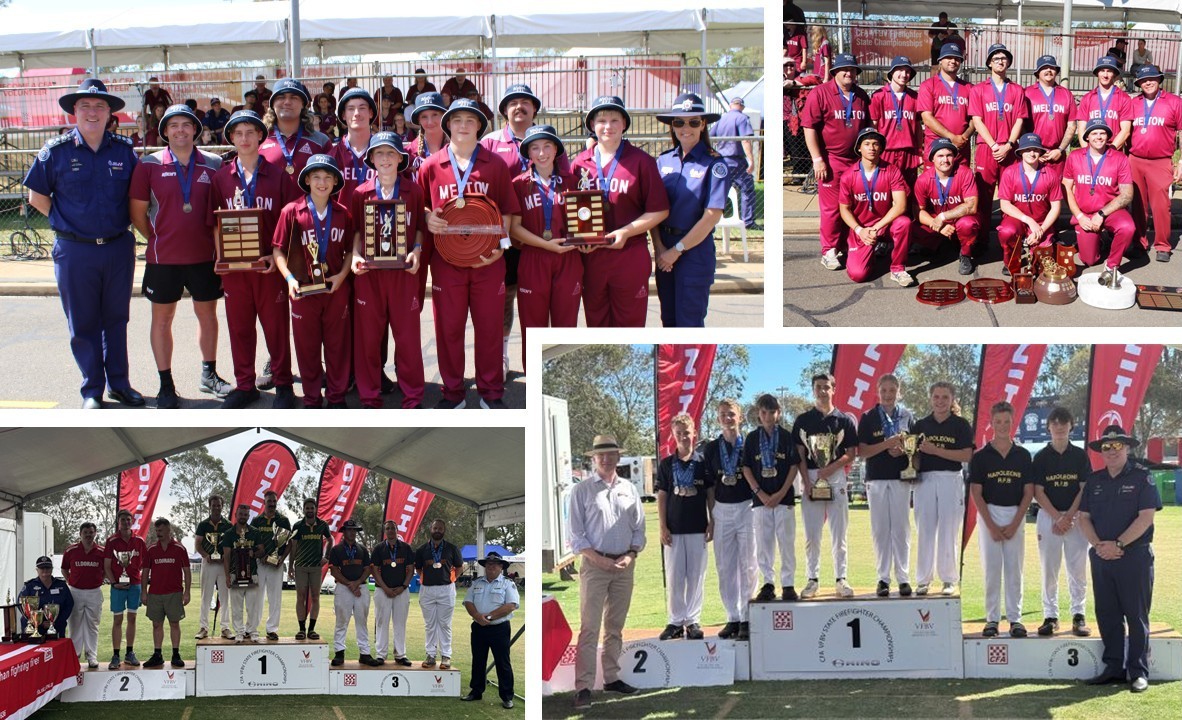
Later this month the 2026 State Championships will be held in Stawell for the first time in 20 years. The Urban Junior Championship will take place on the weekend of 21 and 22 March with the Rural Senior, Rural Junior and Urban Senior Championships taking place the following weekend (28 and 29 March).
Alongside the second weekend of competition the popular Torchlight Procession will be held on Saturday 28 March through the centre of Stawell. Participation in the Torchlight Procession is open to all brigades not just those competing in the State Championships. If your brigade is interested in participating in the Torchlight Procession please reach out to the VFBV office via This email address is being protected from spambots. You need JavaScript enabled to view it.
Each year the Championships rely on more than 200 CFA volunteers who assist as judges and officials at both the Rural and Urban championships. If you are interested in helping out as a judge or official please contact the VFBV office on (03) 9886 1141 or This email address is being protected from spambots. You need JavaScript enabled to view it. to register your interest or find out more information.
Information for competing brigades has been circulated to all brigades who have registered a team and can also be found on the VFBV website.
Thank you
It has been a busy fire season. To all volunteers who have been called upon over the fire danger period – thank you for your outstanding contribution.
We acknowledge your untiring professionalism, experience and skill in keeping your communities safe.
Rebate Scheme
A reminder that the eligible volunteers rebate scheme is now open for eligible volunteers and life members to apply for a rebate on an eligible property under the Emergency Services Tax.
VFBV continues to hear misinformation about eligibility. Some members have reported they are not eligible due to the current rate freeze that paused the primary producer tax rate to last year’s levels.
This pause does not affect the rebate scheme, and members who own their primary place of residence or farm and are listed on the title, are encouraged to assess their eligibility for a rebate by logging into their CFA online account, to complete the CFA eligibility test.
To check the rules and eligibility requirements, you can visit: https://www.vic.gov.au/evrs If you are eligible and own an eligible property, head to Members Online to start the process.
Committee updates
Eight pages of updates from the CFA/VFBV Joint Committees are included in this month’s VFBV Quarterly Supplement that is included in this edition of Fire Wise.
VFBV provides a free copy of Fire Wise to all brigade Captains and Secretaries, as well as all Group Officers and Group Secretaries.
The 2-Minute Briefings from each committee provides a quick way to stay updated on important updates to the issues raised by volunteers through VFBV District Councils.
Electronic copies of the quarterly supplement can be accessed via the VFBV website.
2026 Annual Firefighter Memorial Service
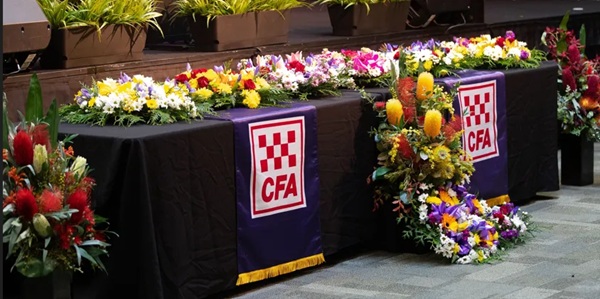
CFA’s Annual Firefighter Memorial Service will be held on Sunday 3 May 2026 at VEMTC Central Highlands, Balan to honour firefighters who have lost their lives in the line of duty while protecting their communities.
The service is held on the Sunday, close to International Firefighters’ Day, and provides an important opportunity for family members, friends, CFA and VFBV executives as well as government representatives to come together to lay wreaths, remember lives and honour the personal sacrifices and commitment firefighters make each and every day.
Attendees are encouraged to RSVP by 20th April via www.cfa.vic.gov.au/rsvp
Contemporary Volunteer Membership Model Options Paper
All members are invited to have your say on a major piece of work, years in the making, that CFA claims will shape the foundations for flexible, clear and modern volunteer membership at CFA now and into the future.
The Options Paper seeks feedback on 13 recommended options that are designed to support real life circumstances and improve the way people join, stay, move between brigades, contribute in different ways, and transition roles over time. All while supporting brigades to broaden and maintain their membership and strengthen capability without the unnecessary burdens.
The options in the paper come directly from what volunteers and brigades have told CFA over the past several years about some of the unintentional barriers in the current model, that limit opportunities for volunteering.
For more information on how to provide feedback to both CFA and VFBV on the options presented as well a link to download the Options Paper visit the VFBV website.
SOP Feedback

CFA has requested VFBV review and provide feedback on 11 updated or new SOP’s. Please visit the VFBV website for links to download each of the SOP’s as well as VFBV’s comparison tables for the 9 updated SOP’s.
Given the importance of SOP’s in CFA’s operational doctrine, all members are encouraged to review and revised SOP’s and provide any feedback, suggestions or amendments including indicating support or non-support for the proposed SOP’s to VFBV ASAP.
Please visit the VFBV website to access the draft SOP’s and change logs to help guide your feedback as well information on how to provide feedback.
Bushfire Recovery Resources
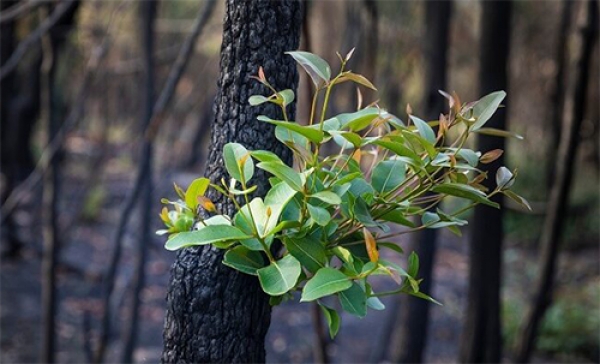
VFBV has collated relevant recovery information and emergency grant information to assist members who may be personally impacted by the emergency.
There are numerous supports available to members, residents, farmers, businesses, individuals and communities but navigating these can be a time consuming and sometimes frustrating exercise with information hard to find and spread across multiple resources.
Please visit the VFBV website to download the latest fact sheet on the current resources and assistance available to impacted members in relation to the 2025/26 bushfires.
As with previous Fact Sheets of this nature, the information is rapidly changing, and we will update the fact sheet as fresh information becomes available.
Recent articles on the VFBV website
Donate Now – Supporting CFA Volunteers in a time of need
Now Open – 2025/26 VFBV Volunteer Survey
International Women's Day 2026
Contemporary Volunteer Membership Model Options Paper
2026 Annual Firefighter Memorial Service
Parliamentary Inquiry into 2026 Fires
Emergency Services Tax Forecast Funding
SOP Feedback – Various Interim SOP’s (October 2025)
2026 State Championships – Information for Competing Teams
Presumptive Legislation Update
Enjoy the VFBV monthly newsletter?
If you enjoy reading the VFBV newsletter each month, why not share it with your fellow volunteers?
Either share this page with others who may enjoy the articles or encourage other volunteers to sign up to receive their own copy via email each month here.
Want to read the VFBV 2-minute briefings from the CFA/VFBV Joint Committees?
The latest edition along with previous editions can be downloaded from the VFBV website here.
